
The mobile app industry has become more competitive than ever. Launching an app is just the beginning. The real challenge is attracting users who not only download your app but continue using it over time. This is why businesses today focus heavily on performance marketing, where every advertising dollar is measured against real business results.
Among the most popular app growth strategies, CPA and CPI performance marketing stand out as two effective yet very different approaches. While both help brands acquire users, they work in different ways and serve different business goals. Understanding these differences can help marketers invest their budgets wisely and achieve sustainable app growth.
Why Performance Marketing Matters for Mobile Apps
With millions of applications available across app stores, relying solely on organic downloads is no longer enough. Affiliate marketing allows businesses to partner with publishers, influencers, media buyers, and performance networks that promote an app to targeted audiences. Instead of spending heavily on broad advertising, brands only pay when a predefined marketing objective is achieved. This performance-driven approach reduces unnecessary spending and gives advertisers better control over campaign results.
However, before launching a campaign, businesses need to decide whether they should pay for every install or only for users who perform meaningful actions after installing the app. That’s where CPA and CPI marketing become important.
Understanding CPI Marketing Beyond Just App Installs
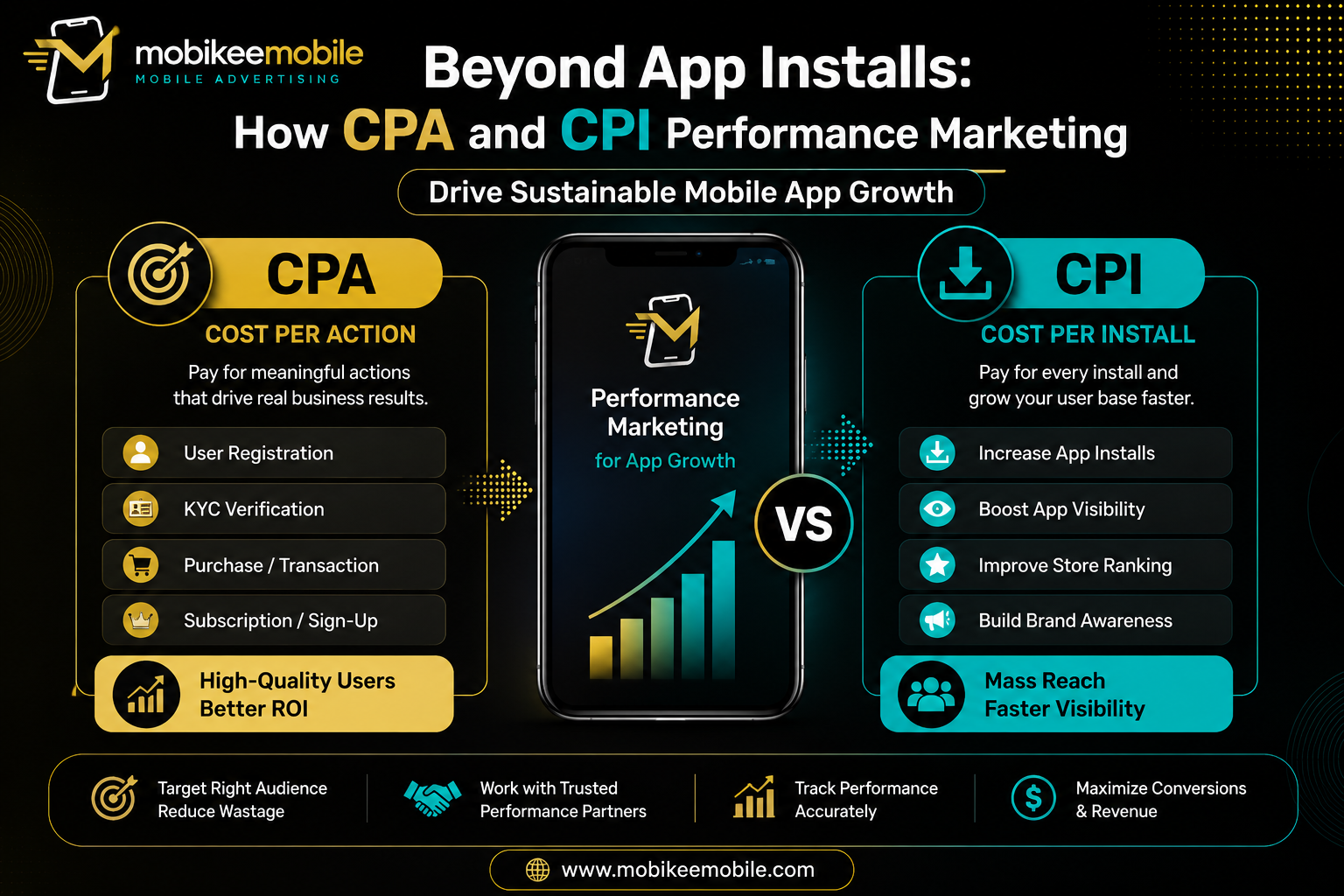
CPI, is one of the simplest pricing models in mobile app marketing. Under this model, advertisers pay affiliates whenever a user successfully installs their application. The payment is triggered by the installation itself, regardless of whether the user opens the app again or leaves it unused after the first day.
For startups and newly launched applications, CPI campaigns can be extremely valuable because they help build initial momentum. A higher number of downloads often improves an app’s visibility in app stores, increases brand awareness, and creates social proof. When users see an app with thousands of downloads, they’re generally more likely to trust it.
While CPI is excellent for increasing download numbers, businesses should remember that installs alone don’t guarantee revenue. If users don’t engage with the app after downloading it, marketing costs can rise without delivering meaningful business growth.
How CPA Marketing Focuses on Business Results
Unlike CPI and CPA marketing takes a more outcome-driven approach. Instead of rewarding affiliates for app installs, advertisers only pay when users complete a specific action that matters to the business. This action could be registering an account, completing KYC verification, making a purchase, subscribing to a paid plan, or even booking a service.
This model shifts the focus from quantity to quality. Rather than collecting thousands of installs, businesses concentrate on attracting users who genuinely interact with the app and contribute to revenue. Because payment is linked to measurable business outcomes, CPA campaigns often provide better long-term returns for industries such as fintech, e-commerce, education, gaming, travel, and subscription-based platforms.
The Biggest Difference Between CPA and CPI
Although both marketing models are designed to acquire users, they measure success differently. CPI rewards the first step of the customer journey of the installation while CPA rewards valuable actions that happen after the install.
Think of it this way. If one thousand people install your app but only twenty of them make a purchase, a CPI campaign still pays for all one thousand installs. In contrast, a CPA campaign only pays for the twenty users who actually completed the desired action. This makes CPA a smarter option for businesses focused on profitability rather than download numbers.
On the other hand, if your goal is to create awareness for a newly launched app and quickly reach a large audience, CPI campaigns can still play a very important role.
Which Model Delivers Better Return on Investment?
When marketers discuss ROI, CPA often comes out ahead because it directly connects advertising costs with business performance. Every payment contributes toward a measurable objective, making it easier to evaluate campaign success.
CPI campaigns can also produce excellent results, but only when supported by strong onboarding, user engagement, and retention strategies. Without these, businesses may end up paying for users who uninstall the app within a few days.
The best-performing apps don’t simply count installs; they measure how users interact with the product after downloading it. This is why many companies today prioritize customer lifetime value instead of download volume alone.
Why Many Brands Use Both Strategies Together
Choosing between CPA and CPI doesn’t always have to be an either-or decision. In fact, many successful brands combine both strategies to achieve balanced growth.
A company launching a new app might first run CPI campaigns to increase visibility and attract a large user base. Once enough users have downloaded the app, the focus shifts to CPA campaigns that encourage registrations, purchases, subscriptions, or other valuable actions. This combination allows businesses to benefit from both broad reach and high-quality conversions without relying entirely on one marketing model.
How to Decide Which Strategy Is Right for Your Business
The right choice depends entirely on your marketing objectives. If your primary goal is to increase downloads quickly and improve your app’s ranking on the App Store or Google Play, CPI marketing is likely the better option. It creates awareness and helps new apps gain traction during their early stages.
However, if your business is more concerned with acquiring paying customers, improving customer retention, and generating higher revenue, CPA marketing is usually the stronger investment. Since payments are linked to meaningful user actions, businesses can optimize their marketing budgets more efficiently while attracting higher-quality users.
The Future of Mobile Performance Marketing
As mobile advertising continues to evolve, businesses are moving beyond simple install-based metrics. Today’s marketers pay close attention to engagement, customer retention, lifetime value, and overall profitability. Artificial intelligence, advanced attribution tools, and data-driven optimization are making it easier than ever to identify users who are most likely to convert.
This shift is changing the way companies approach performance marketing. Instead of chasing the highest install numbers, brands are investing in strategies that deliver real business outcomes. CPA marketing is becoming increasingly popular for this reason, while CPI remains valuable for building awareness and reaching new audiences.
Conclusion
When comparing CPA vs CPI performance marketing, there isn’t a single solution that works for every business. Both models have unique strengths and are designed to achieve different objectives. CPI is ideal for generating visibility, increasing downloads, and giving new apps a strong market presence. CPA, on the other hand, focuses on attracting users who take meaningful actions and contribute directly to business growth.
The most successful app marketing strategies often combine both approaches, using CPI to attract users and CPA to maximize conversions and long-term revenue. By understanding your business goals, target audience, and growth priorities, you can choose the strategy or combination of strategies that delivers the best results for your mobile app.